What is the soil food web?
The soil food web consists of soil organisms and the flow of energy and matter between them, from bacteria and fungi to protists, nematodes and larger animals.
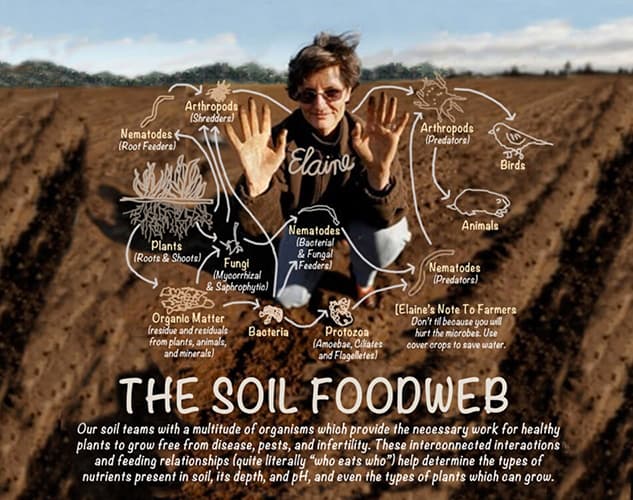
The soil food web is the community of organisms living in soil and the relationships between them. Bacteria are part of it, but do not form an ecosystem on their own.
Who makes up the web?
Its members include:
- bacteria and archaea,
- fungi,
- protists,
- nematodes,
- microarthropods,
- earthworms and other larger soil organisms.
Each group has different functions and food sources. Two soils containing bacteria can therefore work very differently if the other parts of their food webs differ.
What happens to nutrients?
Bacteria and fungi break down organic matter and hold some nutrients in their biomass.
Nutrients return to circulation through many pathways. One is protists and nematodes feeding on bacteria and fungi. Some of the nutrients they consume are then released in mineral forms available to plants.
That is why relationships between levels of the web matter, not just bacterial numbers.
The web also shapes soil structure
Fungal threads, substances produced by microorganisms and the activity of larger organisms help form and stabilise soil aggregates.
These aggregates influence space for air and water, and resistance to erosion and compaction.
Diversity can suppress some pathogens, but offers no guarantee
Organisms compete for space and resources, and some eat other microorganisms. A complex community can therefore make it harder for certain pathogens to develop.
This does not mean that “living soil never gets disease”. The effect depends on the pathogen, plant, conditions and composition of the whole community.
How can the web be examined in a sample?
At BioFarmLab we examine samples under the microscope, looking at bacteria, fungi, protists and nematodes, among other groups, and their proportions.
The microscope is an observation tool. A person interprets the result in the context of the material, plant and purpose of the test.
Simply finding bacteria does not answer the key question: does the sample contain a complex, functioning web?
Sources
- USDA NRCS, Soil Biology Primer
- Ingham R.E., Trofymow J.A., Ingham E.R., Coleman D.C. (1985), Interactions of Bacteria, Fungi, and their Nematode Grazers: Effects on Nutrient Cycling and Plant Growth, Ecological Monographs 55:119–140
- BioFarmLab, original Polish article “Czym jest glebowa sieć pokarmowa?”, 22 May 2021