Why bottled microbes cannot rebuild degraded soil on their own
An inoculant can increase selected microorganisms, but cannot by itself recreate their habitat or the entire soil food web.
Biologically depleted soil need not be sterile. Bacteria can be found, fungal DNA detected and, after applying a product, microbial biomass may even increase.
Yet the soil ecosystem may still fail to function. The presence of microorganisms is not the same as a working ecosystem.
Bacteria are not an ecosystem
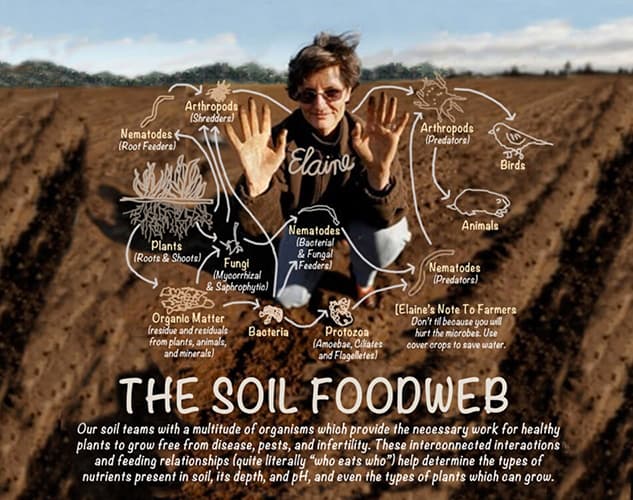
Healthy soil does not function simply because it contains many bacteria. It works through a web of organisms exchanging energy and nutrients:
- bacteria,
- fungi,
- protists,
- nematodes,
- microarthropods,
- organisms at further trophic levels.
Each group has a different role. Bacteria and fungi hold nutrients in their biomass and decompose organic matter. But storing nutrients in microbial cells is not enough.
Organisms that feed on bacteria and fungi are needed too. This feeding releases some nutrients again in forms plants can use. That is cycling.
One microorganism cannot create a cycle, just as one animal species cannot make a forest.
What a classic food-web experiment showed
In Ecological Monographs, Russell Ingham, J.A. Trofymow, Elaine Ingham and David Coleman examined how adding groups of organisms affected nutrient cycling and plant growth.
Plants with bacteria alone did not respond like systems that also contained organisms feeding on the microflora. In combinations with bacteria and bacteria-feeding nematodes, plants grew faster and initially took up more nitrogen. Increased mineralisation and nitrogen released through grazing were among the reasons.
This is a fundamental distinction. Microorganisms alone are not enough: relationships between successive levels must exist.
More biomass does not mean a restored system
It is easy to mistake a measured result for the goal. If an inoculant increases microbial biomass, we can say biomass increased. That does not establish ecosystem recovery.
A meta-analysis of 335 studies in Nature Ecology & Evolution found that inoculation increased soil microbial biomass on average. It did not increase microbial diversity, altered community composition and reduced bacterial network complexity.
This highlights the difference between asking “Are there more microorganisms after application?” and “Has a complete, stable, functioning food web developed?” These are different questions.
Why a bottle does not repair habitat
Soil organisms need suitable living conditions. If repeated disturbance has damaged structure, organic matter, fungal continuity, stable aggregates and water–air conditions, pouring in microbes does not recreate them.
Reviews of inoculant research help explain variable field results. Survival and function depend on factors including:
- pH,
- nutrients and organic carbon,
- moisture,
- host plant,
- the existing microbial community,
- competition for niches,
- application method,
- the organism’s ability to survive and colonise.
In many experiments, introduced populations declined after application. Adding an organism does not guarantee survival, establishment or lasting membership of the web.
Like treating tuberculosis with cough syrup
A cough is a symptom, and syrup can affect that symptom. The underlying problem lies deeper.
The analogy applies to biologically degraded soil. Adding bacteria may produce a temporary plant response or measurable biomass increase. But without habitat for fungi, microbial predators and further food-web levels, the system has not been rebuilt.
One component has been added to a whole that still does not function.
What repeated soil disturbance does
In her teaching, Elaine Ingham describes repeated disturbance as pushing the system towards very early succession: strongly bacterial, with few fungi and simplified higher levels.
Fungal threads form spatial networks. Mechanical inversion and tearing break them. Structural disturbance also affects water, air and protection within aggregates. Chemical interventions can add further selective pressures.
The question is therefore not “Can any microorganisms still be found?” Of course they can. It is “Is there a functioning, appropriately structured ecosystem?”
What we see in the BioFarmLab laboratory
In our experience reported here, this pattern recurs in agricultural soil samples sent to us. We had not received one we assessed as a biologically well-structured, balanced ecosystem.
Most showed a simplified, bacteria-dominated system without a well-developed fungal component or the full subsequent levels of the web.
Good samples do occur, especially well-made composts and material from well-managed gardens. That is an important difference.
Establish the starting point first
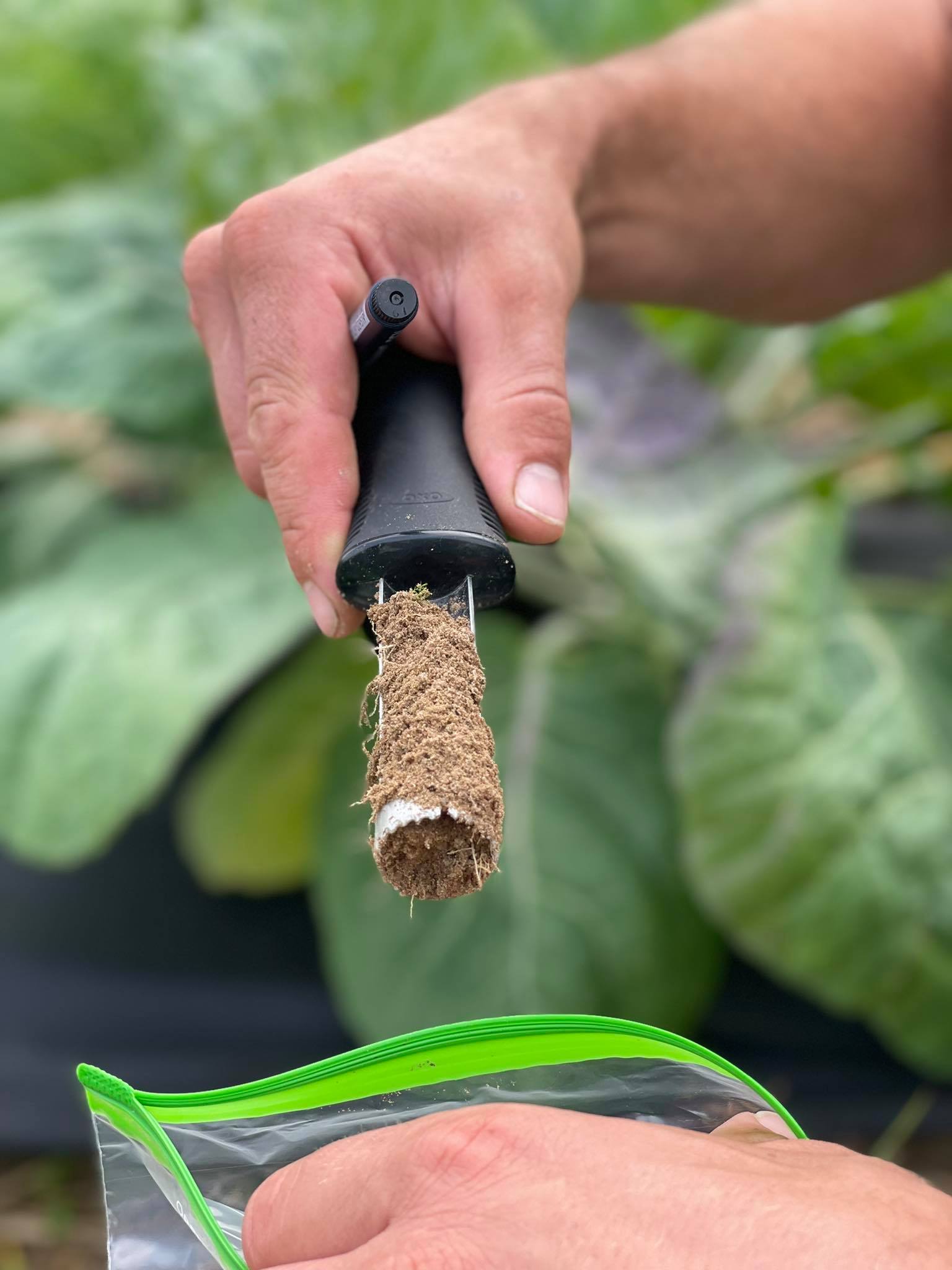
Regeneration benefits from a baseline before changes. Biological testing can show:
- whether the system is almost entirely bacterial,
- whether substantial fungal biomass is present,
- whether protists occur,
- whether nematodes are present and which groups they represent,
- whether further functional levels are visible.
This clarifies what is missing. Retesting after changes can show whether the system moved in the desired direction.
Without a baseline, success or failure is easily attributed to a product without knowing what existed before application.
Does this mean inoculants are never useful?
No. Microorganisms can be useful tools in a specific context. But a tool is not a system.
If assessment identifies a particular gap, conditions support the organisms and application forms part of a broader recovery strategy, inoculation may be useful.
The problem starts when a bottle is sold as a substitute for rebuilding soil. An ecosystem cannot be bought in one bottle.
Sources
- Ingham R.E., Trofymow J.A., Ingham E.R., Coleman D.C. (1985), Interactions of Bacteria, Fungi, and their Nematode Grazers: Effects on Nutrient Cycling and Plant Growth, Ecological Monographs 55:119–140.
- O’Callaghan M. (2022), Soil microbial inoculants for sustainable agriculture: Limitations and opportunities, Soil Use and Management.
- Li C. et al. (2024), Meta-analysis reveals the effects of microbial inoculants on the biomass and diversity of soil microbial communities, Nature Ecology & Evolution 8:1270–1284.
- Ribeiro R.C. et al. (2026), Microbial inoculants and root microbiome: a path to sustainable agroecosystem management, npj Sustainable Agriculture.