What happens to manure after 3, 7 and 21 days of composting?
BioFarmLab documented the transformation of strong-smelling stable manure: its odour and biology changed within days, and observations continued to day 21.

Stable manure that initially smelled so strongly it was hard to stand beside stopped stinking after the first turning, about three days into our experiment. The odour clearly disappeared and the structure began changing. A week later the material had progressed further; the last turning shown took place after 21 days. We recorded the stages in a four-part BioFarmLab series and examined samples from successive stages under the microscope.
This article brings those observations together and explains why change happened so quickly. It documents the transformation and its mechanism, leaving detailed pile management outside its scope.
Our starting material
We began with horse manure from a stable: wet, compacted and very unpleasant-smelling. For a stable owner, such material is primarily a difficult mass to store and hardly looks like a valuable soil amendment.
The smell has a cause. Oxygen struggles to enter a heavy, wet, compacted heap, so decomposition takes place with insufficient oxygen. Compounds responsible for sharp, rotten odours develop. The smell signals a particular process, rather than an unavoidable “normal fertiliser smell”.
It also warns us about the material as a whole. Raw manure needs transformation through a controlled process before being treated as a prepared amendment. Part one shows the starting condition and the beginning of composting.
Part 1: What to do with stable manure? — video in Polish.
What composting changes
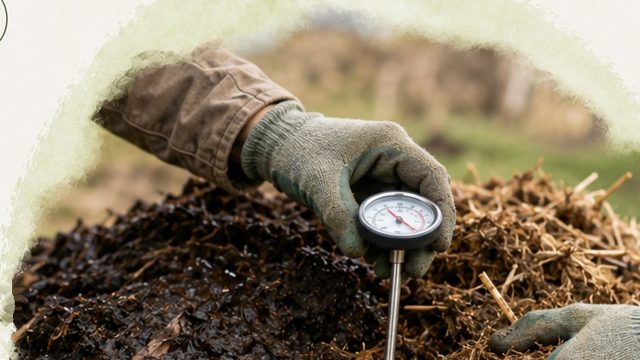
Composting is a controlled biological process in which microorganisms break down organic matter with oxygen. Their activity produces heat. Moving from putrefaction to aerobic decomposition therefore changes both the microbial community and temperature.
Properly managed composting includes a thermophilic, or elevated-temperature, phase. Cornell CALS explains that heat, competition between microorganisms and changing conditions can substantially reduce pathogens. It also distinguishes storing manure from composting: simply leaving a heap to age does not ensure this process. Time alone does not do the work.
That is why change came quickly in our series. Oxygen-limited decomposition in a compacted mass gave way to activity driven by aerobic microorganisms. We deliberately omit the mixture, ratios and turning schedule: the article shows the result and mechanism.
About three days: the first major change
After the first turning, the material looked and smelled different. The stench had clearly disappeared and the structure was changing. The first noticeable changes happened within days, not months.
This shows how quickly the direction can change when active aerobic processing replaces putrefaction. It is still only the beginning. Odour loss indicates changed conditions; it is not evidence that compost is already ready.
Part 2: Composting manure for stables — video in Polish.
After a week
Part three documents the material after about seven days. The film asks what can be achieved with manure in a week and shows the answer in the material. This checkpoint lies between the first rapid change and the end of the series. Transformation is continuing.
A week is still within the active phase. Compost maturation is a separate, longer stage that follows.
Part 3: Composting stable manure — video in Polish.
After 21 days
Part four shows day 21 and the last turning in the series. Its description also reports fuel use: around 2 litres of diesel and 0.5 litres of petrol. This records machine fuel input for the batch’s documented cycle.
After three weeks the material looks different: an offensive, putrefying waste has become material worth working with further. But 21 days marks the end of the active phase we observed, not automatic maturity. Odour and structure can change quickly; full maturation takes longer.
Safety is a separate question too. Cornell distinguishes controlled composting from raw manure and explains that use on produce farms involves additional requirements and process records. Twenty-one elapsed days do not replace that documentation.
Part 4: The final turning — video in Polish.
Why use a microscope?
Smell and appearance show only part of the change. Manure can stop smelling and change texture while its biology is still developing. We therefore collected samples at successive stages, including the initial material and after composting began, to compare the biology.
The microscope is an observation tool; a knowledgeable person interprets what is seen. This article does not report counts or organism identifications. The observations and commentary are in the videos.
Watch the series in order
- Part 1: the starting point. Strong-smelling stable manure and the start of composting.
- Part 2: the first major change. Odour disappears and structure changes within days.
- Part 3: around one week. The transformation continues.
- Part 4: 21 days. Final turning and fuel use. All four videos are in Polish.
If your pile does not change or warm up, read why a compost pile may stay cold.
For the next assessment, see when compost is ready to use. To examine the organisms in your batch, explore biological compost testing.
Sources
- Cornell CALS, Science and Engineering of Composting
- Cornell CALS, Soil Amendments
- Cornell CALS, Compost Use on Produce Farms
- BioFarmLab four-part YouTube series linked above